Local SEO for plumbers is the process of improving a plumbing business’s online presence to rank in local Google search results, attract nearby customers, and convert searches into booked jobs through fast response and consistent follow-up.
Plumbing is a location-driven service. Customers search when a problem exists, and the business that appears first and responds fastest captures the job. For commercial plumbing businesses, local SEO also builds the kind of trust that facility managers look for long before they pick up the phone.
Why local SEO is important for plumbing companies
Plumbing demand is urgent, local, and competitive. Most plumbing searches include geographic intent, whether that is a city name, a neighborhood, or a “near me” modifier. Google prioritizes businesses that demonstrate proximity, relevance, and trust. A plumbing company that does not rank locally is invisible to customers who are ready to book.
Several factors make local SEO especially important for plumbing companies:
- Plumbing emergencies require immediate service. A burst pipe at 10 PM sends a homeowner straight to Google, and they call whoever shows up first on a phone screen that fits three results.
- Over 60% of plumbing searches happen on mobile devices, where screen space limits visible options. That percentage climbs even higher for emergency situations.
- Customers tend to contact the business that responds first, not the one with the longest service history. Speed of response is as much a ranking factor in practice as it is an operations metric.
Local SEO determines who gets considered. What happens after that first call determines who gets selected.

SEO for commercial vs residential plumbing
Local SEO applies to all plumbing businesses, but the way it works in practice differs depending on the type of customer you serve.
Residential plumbing SEO
Residential plumbing searches are driven by urgency and convenience. Homeowners tend to make fast decisions and prioritize:
- Proximity to their location
- Same-day or emergency availability
- Review ratings and recent review volume
- Speed of response when they call or message
A homeowner with a flooded basement is not comparing three proposals. They are calling the first plumber they see with good reviews and a phone number that works.
Commercial plumbing SEO
Commercial plumbing SEO targets property managers, facility operators, and business owners. These buyers evaluate more carefully and prioritize:
- Scope of services and capacity to handle commercial-scale work
- Credentials, licensing, and compliance documentation
- Experience with commercial facilities, not just residential
- Proof of reliability and follow-through on past jobs
Commercial customers may not book immediately, but consistent visibility across searches builds trust long before the first call. A facility manager who sees the same plumbing company appear in search results, on review sites, and in local directories over several months is far more likely to reach out when a contract opens up.
The rest of this guide is written with commercial and hybrid plumbing businesses in mind.

How local SEO works
Local SEO works through a combination of signals that help Google decide which plumbing businesses should appear in local results. No single signal dominates. What matters is how consistently they reinforce each other.

Signals Google uses for local rankings
Google evaluates three main signal categories when ranking local results:
- Your Google Business Profile is the most direct signal. Categories, service areas, activity level, and engagement all influence where you appear. A profile that sits untouched for months sends a different message than one with regular posts, new photos, and recent review responses.
- Your website confirms what services you offer, where you offer them, and whether your business is legitimate. Google looks for service-area pages, contact information, and content that matches the searches you want to rank for.
- Trust signals round out the picture. Reviews, citations on directories and industry sites, and consistent business information across the web all validate your real-world presence.
A plumbing company with 200 reviews on Google, matching business details on Yelp and Angi, and a website that clearly lists its service areas gives Google more confidence than one with a bare-bones profile and no third-party validation.
What you can do to appear in top local results
Ranking in local search requires steady execution across a few core areas, not a single tactic done once.
a. Set up and maintain your Google Business Profile
Google Business Profile is the fastest way for plumbing companies to improve local visibility. The setup matters, but ongoing maintenance matters more.
Start by selecting accurate primary and secondary categories. “Plumber” as a primary category with secondary categories like “Drain cleaning service” or “Water heater installation service” helps Google match your business to more specific searches. Define realistic service areas rather than claiming an unrealistically large radius.
After setup, focus on ongoing activity:
- Post photos of completed jobs and your team regularly
- Share updates when you add services or expand to new areas
- Respond to every review, positive or negative, within a day or two
- Keep business hours, phone numbers, and service descriptions current
Google evaluates engagement behavior, not just profile completeness. Businesses with fully set-up profiles are 50% more likely to be considered for purchases. That gap widens for service businesses where trust matters as much as proximity.
b. Use local keywords on your website
Your website should clearly communicate what services you offer and where you offer them. This means referencing service areas naturally throughout your content, not just on a single “Service Areas” page.
Create service-specific pages for your core offerings. A page dedicated to “commercial drain cleaning in [city]” performs better than a generic services page that lists everything. Each page should describe what the service involves, which types of facilities or properties you serve, and what the customer can expect.
Avoid repetitive or stuffed location phrases. Writing “plumber in Dallas, Dallas plumbing, Dallas TX plumber” in the same paragraph does not help rankings. It hurts readability and signals low-quality content.
c. Improve your website structure
A plumbing website supports local SEO by confirming relevance and converting visitors into leads. The structure needs to do both. Key elements include:
- Service-specific pages for each core offering, giving Google clear signals about what you do
- Fast load times and mobile compatibility, since most visitors arrive on a phone
- Clear calls to action: a visible phone number, a contact form, or an online booking option
For plumbing sites, where most visitors arrive with an urgent problem, speed is not a nice-to-have.
Ranking traffic that does not convert produces no business value. A site that ranks well but loads slowly or buries the phone number loses the very customers SEO brought in.
d. Get more customer reviews
Reviews influence both rankings and customer decisions. A plumbing company with 15 reviews from 2022 looks very different from one with 80 reviews from the past six months, even if both have similar star ratings.
A strong review strategy focuses on:
- Consistent acquisition over time rather than occasional bursts. Ask after every completed job while the experience is fresh.
- Responding to every review professionally, including negative ones. How you respond to criticism tells potential customers more about your business than the complaint itself.
- Using feedback to reinforce trust. Mention specific services or outcomes in your responses when relevant.
e. Keep business details consistent across the web
Inconsistent business information weakens local rankings. Your name, address, and phone number should match exactly across:
- Your website
- Google Business Profile
- Yelp, Angi, and other review platforms
- Industry directories and local business listings
Even small discrepancies can reduce confidence in your listing. A phone number with an extra digit, a suite number listed on one site but not another, or a business name that varies between “ABC Plumbing” and “ABC Plumbing LLC” can all create confusion for both Google and potential customers.
Audit your listings at least once a quarter. Fix inconsistencies as soon as you find them.
Local SEO for plumbing companies in competitive cities
The fundamentals stay the same regardless of market, but competition density changes what it takes to rank. For example, a plumber in New York competes against more listings than a plumber in Houston. A plumber in Miami may face seasonal demand swings that change search volume month to month. A plumber in Chicago may find that reviews carry more weight in a crowded field where dozens of businesses offer similar services.
In competitive markets, the bar is higher across every signal:
- Stronger review velocity, meaning more reviews coming in consistently, not just a high total count
- More consistent profile activity, because competitors who post weekly will outpace a profile that goes quiet for months
- Faster response times, because customers in dense markets have more options and less patience
The ranking systems stay the same. The threshold for visibility goes up.
Why being on page one doesn’t always mean more jobs
Most local SEO failures do not happen at the ranking stage. They happen after visibility is achieved.
The pattern is common. A plumbing company invests in SEO, starts ranking for target keywords, and sees an increase in website traffic and phone calls. But revenue does not grow at the same rate. The gap between traffic and booked jobs is almost always operational.
Common breakdowns include:
- Missed calls during jobs or after hours, with no system to capture and return them
- Delayed responses to form submissions or messages. A customer who fills out a contact form at 7 AM and does not hear back until 3 PM has already called someone else.
- Estimates sent without follow-up, sitting unanswered in inboxes
- Job details lost between the field and the office
- Repeat customers not tracked, keeping acquisition costs high even as the customer base grows
Ranking increases the volume of opportunities coming in. But if the systems to handle those opportunities are not in place, the traffic does not convert.
Turning local SEO traffic into booked plumbing jobs
Visibility only matters when it connects to execution. Plumbing businesses that convert traffic consistently share a few traits:
- They capture leads immediately. Whether it is a phone call, a form submission, or a message through Google Business Profile, the lead goes somewhere it will not be missed. No voicemail black holes, no unmonitored inboxes.
- They respond fast. The window between a customer’s first search and their decision is short, especially for emergency work. Businesses that respond within minutes win more jobs than businesses that respond within hours.
- They follow up in a structured way. An estimate that goes out without a follow-up call or message three days later is an estimate that often dies quietly. Structured follow-up turns maybe into yes.
The businesses that do these things well do not just get more calls. They close more of the calls they get.
How ResQ supports plumbing businesses after they rank
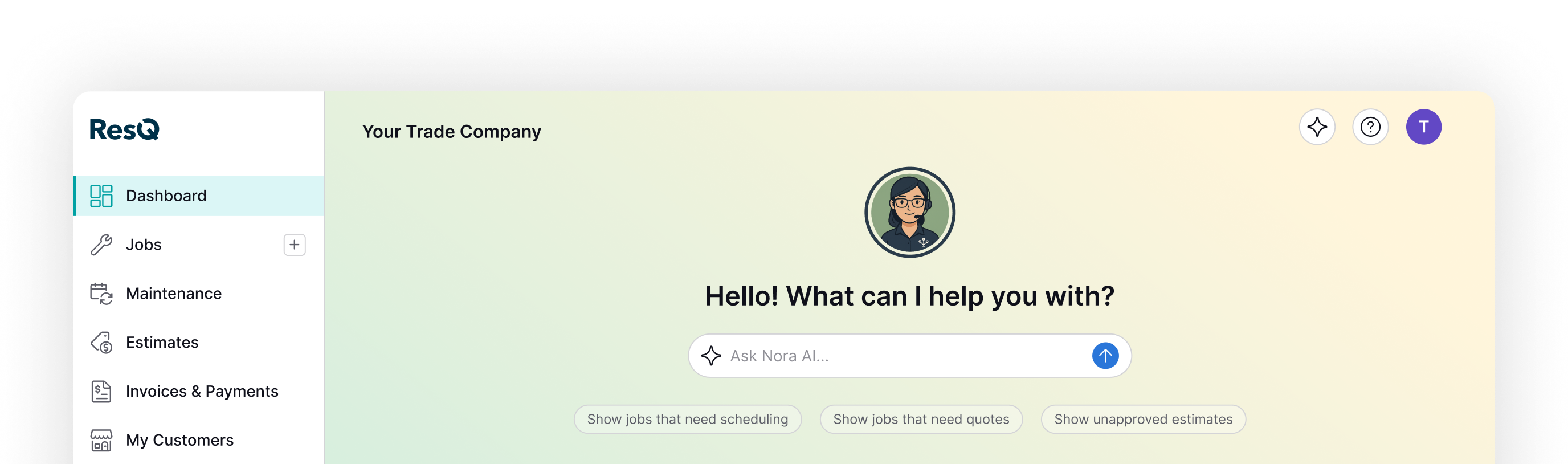
Some plumbing businesses address the execution gap by using a growth platform built for trades.
ResQ is one example. It helps plumbing businesses:
- Get found in local search through an online presence and profile on the ResQ network
- Capture calls and messages so fewer leads slip through the cracks
- Keep job details organized from first contact to invoice
- Connect with commercial facilities and property operators looking for qualified trades
The idea is straightforward: SEO creates demand, and systems determine whether that demand turns into booked work. A plumbing company that ranks well and responds to every inquiry is in a fundamentally different position than one that ranks well but loses half its leads to missed calls and slow follow-up.
Common local SEO mistakes plumbing companies make
Several mistakes limit what plumbing companies get back from local SEO:
- Ranking without response systems. Traffic comes in, calls go unanswered or unreturned, and the SEO investment produces a fraction of what it should. The fix is not more SEO. It is better operations.
- Treating all services as one generic page. A single “Our Services” page that lists plumbing, drain cleaning, water heater installation, and pipe repair in a few bullet points does not compete with a competitor who has a dedicated page for each.
- Ignoring existing customers. A plumbing company that does not track past clients or follow up on completed jobs misses the easiest revenue available: repeat business and referrals from people who already trust them.
- Treating SEO as a one-time project. Competitors keep posting, keep collecting reviews, and keep building new pages. A profile and website that were strong six months ago can slip without consistent upkeep.
Final takeaway
The plumbing companies pulling the most revenue from search are not the ones with the best rankings alone. They are the ones that answer fastest, follow up consistently, and treat every lead like it matters.
Strong rankings get you in front of the customer. Everything after that is operations.